


Mince pies have been associated with Christmas since at least the 17th century. In 1662 Samuel Pepys wrote a diary entry for the 6th of January of an evening's repast with his friend Sir William Penn. Sir William served Pepys 'a good chine of beef and other good cheer, eighteen mince pies in a dish, the number of years that he [William] has been married.'
From the date (6th January), it sounds as if Pepys may also have been participating in another tradition associated with mince pies; that of eating one a day over the twelve days of Christmas (which run until the 6th of January). The custom is that each pie is meant to bring you happiness for a month, so if you have eaten the full quota then a happy year is on the cards. You are supposed to eat each mince pie as the guest of a different household.
Earlier in the 17th century the Puritans banned mince pies (along with many other things) as symbols of indecent excess. They felt that Christmas celebrations were getting out of hand, and that the true significance of Christmas was being overlooked. In 1644 they passed an Act of Parliament that banned Christmas celebrations, although no doubt some more discreet pleasures (such as food) continued to be observed. With the Restoration in 1660 came a return to pre-Puritan festivities, so Samuel Pepys was partaking in the renewed enjoyment of dishes such as mince pies. For the Scottish the ban on Christmas celebrations came even earlier, with the ousting of the Catholic Church in 1583, and was continued by the Presbyterians right through into the 20th century. See this site for more information.
The mince pies we eat today have an ancestry reaching back to Medieval times. During the Medieval period meat and fish pies were often sweetened with dried fruits, sugar and spices. A small pie known as a 'chewette' was based either on meat or fish, depending on whether it was a fasting (non-meat) day or not. These pies were enriched with fruits and spices. The Medieval cook had a fondness for using such ingredients, most likely because of their 'exotic' nature, just as we today like to seek out ingredients from across the globe. In the 16th century similar pies were known as 'shred', 'shredded' or 'minced' pies - names that described the preparation of the meat content. From the mid 17th century onwards the meat content of the pies gradually reduced, although Mrs Beeton writing 200 years later gave a recipe for mincemeat based on mutton. In 2005 the majority of the mincemeat spooned into our mince pies is meat-free, but much still includes beef suet - and so we continue to eat the distant relations of the Medieval chewette, and the Tudor shred(ded) pie.
I have eaten many a mince pie, but had never experienced a mince MEAT pie, so for this posting I decided to try the original formula. For my pies I used a mincemeat recipe from the 21st century foodie and chef Hugh Fearnley-Whittingstall. Hugh is a great fan of British beef and his Christmas recipes make good use of the meat. He rates his meaty mincemeat pies as the best he has eaten. I have to confess that the thought of mincing up a raw, bloody steak and mixing it with dried fruits and spices, and then putting it into a jar to 'mature', did seem a little queer. I make a batch of mincemeat each year, and love the way the kitchen becomes scented with warm and delicious smells; not this time though. Perhaps it was the thought of bottling up raw mince that was off-putting. I followed Hugh's advice to double the amount of brandy in the recipe, which should allow it to be stored for up to a year! I also added a dash of whisky (for luck).
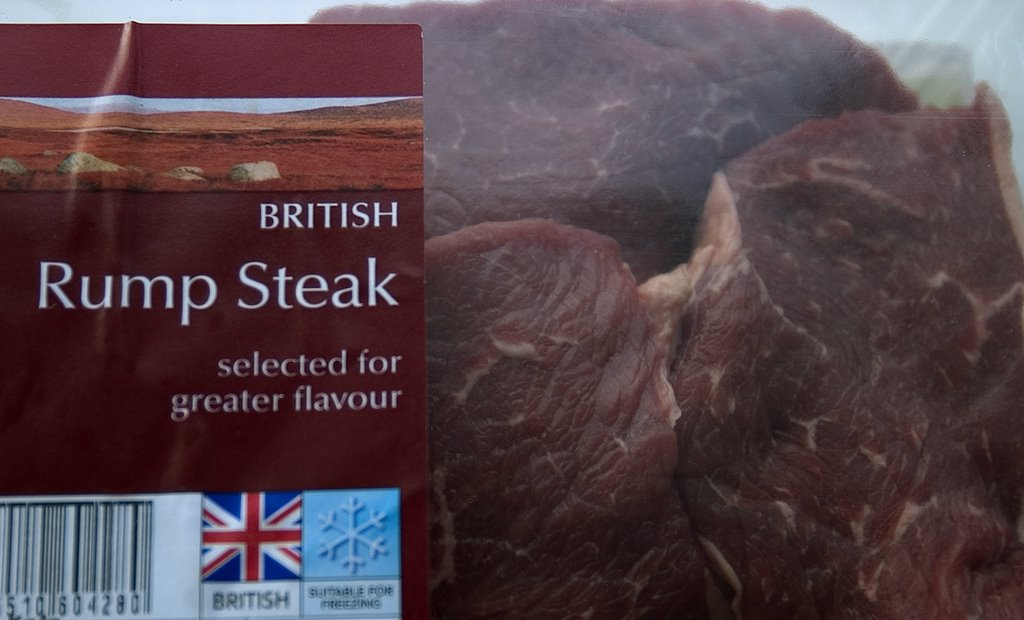 ...well, does this say 'mince pie' to you?
I made the mincemeat a month ago, and have had it in the fridge maturing. The unmistakedly red raw mince content quickly darkened in colour, and the overall look of the mincemeat now looks unintimidating. It is a fairly dry looking mixture, unlike the mincemeat I normally produce, which has a lot more apple in it and even more booze! I gave it a good sniff when I opened the jar and was pleased to remain on my feet. Sadly, this also meant that the spices give a much subtler scent than my previous mincemeats. Nothing left to do but taste it. I made up a batch of shortcrust pastry and rolled out my pie cases.

I spooned a small (teaspoon) amount of the mixture into each case. Jane Grigson carries a recipe for Mrs Beeton's Mincemeat in her book 'English Food', and she warns against overfilling because when the suet melts the filling can overflow the case. Normally I would put more than a teaspoon of mincemeat into each pie, as I think otherwise the pastry can dominate the eating of them.
Pies baked - all still looking innocuous. No overflows of beef fat or other unpleasantness.
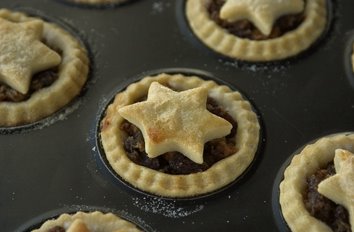
So, were the pies worthy of a festive feast, or should they be fed straight to the dog? There certainly was no hint of the beefy element, and the more subtle flavouring and not so in-your-face sweetness made them seem a lot more sophisticated than the usual mince pie. Mince pies do tend to be filled with sickly sweet mincemeat, and these are quite different. If you don't normally like mince pies then you might take more favourably to these. I did think that they needed more filling to them as the pastry slightly overwhelmed. My shortcrust pastry was plain. I think that the next batch should be made with a sweetened pastry.
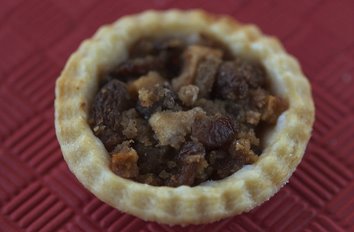 ...a 'topless' pie - to show the appearance of the cooked mincemeat
Did this baking make me feel all festive and full of good cheer? Frankly, I try and save myself until the last few days before the 25th of December, as my good cheer will be very strained if it has to last a whole month. However, in the hope of a great 2006 I think there is no harm in eating one or two mince pies ahead of time just on the off-chance they bring good fortune. May your mince pies make all your dreams come true.








0 Yorumlar